


When it comes to cinematic cars that have left an indelible mark on film history, few are as memorable as the Grindhouse Death Proof car. Featured in Quentin Tarantino’s 2007 film Death Proof, this menacing muscle car became an instant symbol of power, danger, and old-school Hollywood stuntcraft.
The vehicle doesn’t just play a supporting role — it is one of the stars of the movie. Its design, purpose, and the visceral action scenes it takes part in make it one of the most recognizable cars in cult cinema. In this article, we’ll explore what makes the Grindhouse Death Proof car so iconic, from its origins to its cinematic legacy.
The Birth of Grindhouse and Death Proof
To understand the Grindhouse Death Proof car, you have to start with the movie’s unique origin. Grindhouse was a 2007 double-feature collaboration between Quentin Tarantino and Robert Rodriguez, designed to pay tribute to 1970s exploitation films shown in rundown theaters known as “grindhouses.”
Tarantino’s segment, Death Proof, centered around a psychopathic stuntman named Stuntman Mike, played by Kurt Russell, who uses his specially modified car to murder unsuspecting women in high-speed crashes. The movie blended retro filmmaking techniques, practical effects, and raw, real-world stunt driving — all centered on the terrifying and fascinating Grindhouse Death Proof car.
The Car’s On-Screen Persona
In Death Proof, the car isn’t just a prop; it’s a character. The Grindhouse Death Proof car reflects Stuntman Mike’s personality — rugged, dangerous, and coldly calculated. It’s a weapon disguised as a vehicle, a machine built for destruction.
In the film, Mike refers to it as being “death-proof,” meaning he can survive any crash while his victims are obliterated. The driver’s seat is reinforced with a steel cage, while the passenger side remains unprotected — the dark genius of its killer design.
The Car Model: The 1971 Chevrolet Nova
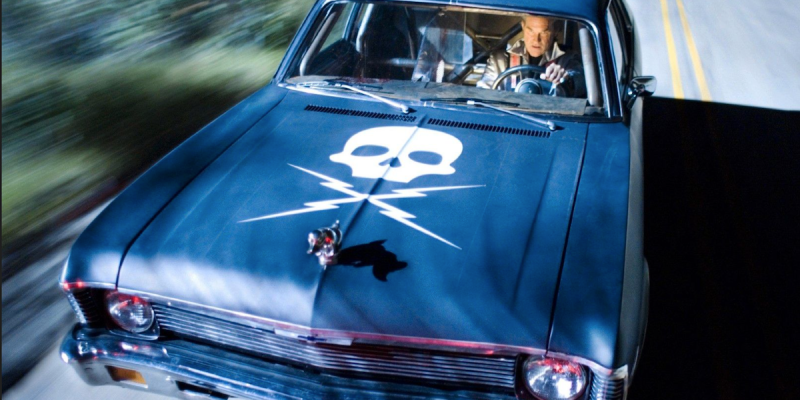
The main Grindhouse Death Proof car used in the first half of the movie is a 1971 Chevrolet Nova. This American muscle car was chosen for its raw power and aggressive look, perfectly fitting Tarantino’s vision of a gritty, dangerous machine.
The Nova was modified extensively for the film:
- Reinforced roll cage to match the “death-proof” claim.
- Matte black paint job for an ominous, killer look.
- A skull and lightning bolts painted on the hood.
- Chrome duck hood ornament — an homage to the 1978 film Convoy.
Every detail of the Grindhouse Death Proof car was meant to evoke 1970s car culture while adding a horror twist.
The Second Car: The 1969 Dodge Charger
In the film’s second half, Tarantino switched things up with another beast — the 1969 Dodge Charger. This version of the Grindhouse Death Proof car serves as the antagonist’s new ride after his first is destroyed.
The Charger, famous for its appearances in films like Bullitt and The Fast and the Furious, symbolizes unstoppable American muscle. Its appearance in Death Proof pays homage to cinema’s greatest car chase legacy. Tarantino’s attention to authenticity meant every stunt was performed practically, using real cars and expert drivers.
Real Stunt Work and Practical Effects
One of the defining features of Death Proof is that all its stunts were done using practical effects — no CGI, no shortcuts. Legendary stunt coordinator Buddy Joe Hooker and professional driver Zoë Bell (who also starred in the film) performed the thrilling, dangerous sequences.
The Grindhouse Death Proof car was engineered to handle real collisions, jumps, and flips. The production used multiple Novas and Chargers, each modified for specific stunts. Some were lightweight stunt cars, while others were reinforced for crash scenes.
Tarantino’s dedication to authenticity made the action feel visceral — every screech, crash, and spark came from real metal, not computer graphics.
The Symbolism Behind the Death Proof Car
The Grindhouse Death Proof car is more than just a machine — it’s symbolic. It represents toxic masculinity, control, and revenge. Stuntman Mike hides behind his car’s invincibility, using it to assert dominance and terrorize women.
But as the film progresses, the tables turn. In the second half, three fearless women — including Zoë Bell playing herself — confront Mike and take him down using his own game. The once “death-proof” car becomes his tomb, symbolizing poetic justice.
The car’s destruction at the end isn’t just an action climax — it’s a metaphorical end to the male power fantasy that the Grindhouse Death Proof car once represented.
Design Details That Made It Iconic
Several distinct design elements make the Grindhouse Death Proof car instantly recognizable to film fans:
- Matte Black Paint: Gives it a sinister, menacing vibe, unlike shiny Hollywood show cars.
- Skull and Lightning Hood Art: A throwback to grindhouse poster art and hot rod culture.
- Metal Duck Ornament: Inspired by Sam Peckinpah’s Convoy, connecting Death Proof to the golden age of car movies.
- Caged Interior: Reinforces the “death-proof” concept while visually symbolizing a killer’s lair.
- Racing Harnesses and Gauges: Reflect Stuntman Mike’s stunt-driving background and obsession with control.
These design choices transform the Grindhouse Death Proof car from an ordinary muscle car into a cinematic legend.
The Legacy of the Death Proof Car
Since the release of Death Proof, the Grindhouse Death Proof car has become a pop culture icon. Fans and car enthusiasts have built replicas, and the original screen-used cars have appeared in exhibitions, car shows, and conventions worldwide.
Collectors consider the Death Proof Nova and Charger some of the most desirable modern movie cars, joining the ranks of icons like the Batmobile, the DeLorean from Back to the Future, and the Mad Max Interceptor.
The film’s cult status continues to grow, and with it, the mystique of the Grindhouse Death Proof car — a reminder of when filmmaking prioritized real stunts over digital trickery.
How Tarantino’s Vision Shaped the Car’s Fame
Quentin Tarantino’s love of 1970s cinema directly influenced the Grindhouse Death Proof car’s design and personality. He wanted a film that felt like a scratched-up VHS tape — raw, dangerous, and unpredictable.
Every aspect of the car, from its creaky doors to its roaring engine, was designed to feel alive. Tarantino also used the car as a storytelling device — a metaphor for power and obsession. The way the camera lingers on the engine, wheels, and metal curves gives the Grindhouse Death Proof car a soul of its own.
In Tarantino’s world, cars aren’t just props — they’re characters with motives, moods, and a voice made of horsepower.
The Real Cars Used in Filming
Several real vehicles were used to bring the Grindhouse Death Proof car to life.
Reports suggest that eight Chevrolet Novas and five Dodge Chargers were customized for production, each designed for specific sequences:
- Hero Cars: Used for close-ups and dialogue scenes.
- Stunt Cars: Reinforced for collisions, jumps, and crashes.
- Camera Rigs: Modified to hold filming equipment during chase scenes.
After filming ended, many of these cars were auctioned off or restored by collectors. A few remain in museums or in Tarantino’s private collection. The surviving Grindhouse Death Proof cars are now among the most valuable and historically significant film vehicles in modern cinema.
Conclusion
The Grindhouse Death Proof car is more than just a piece of Hollywood machinery — it’s a legend of film craftsmanship, stuntwork, and symbolism. Built to thrill and terrify, it embodies everything that makes Tarantino’s movies unforgettable: style, substance, and unapologetic intensity.
From its matte black body to its roaring V8 engine, the car represents an era when danger and art collided on the open road. It remains a symbol of old-school filmmaking and the spirit of rebellion that defines the Grindhouse legacy.
In a world increasingly dominated by CGI, the Grindhouse Death Proof car reminds us that the most powerful machines are still made of real steel, real sweat, and pure cinematic adrenaline.
FAQs
1. What car was used in Death Proof?
The main Grindhouse Death Proof car was a 1971 Chevrolet Nova, customized with a matte black finish, skull emblem, and roll cage. Later in the movie, a 1969 Dodge Charger appears as the second car.
2. Is the Death Proof car real?
Yes. Multiple real cars were built and used for the stunts in Death Proof. All the action scenes were filmed using practical effects and live driving — no CGI.
3. Who drove the Grindhouse Death Proof car?
In the movie, Kurt Russell played the driver, Stuntman Mike. In real life, professional stunt drivers and Zoë Bell, who also starred in the film, handled most of the driving.
4. Where is the Death Proof car now?
Several of the Grindhouse Death Proof cars still exist. Some are in private collections, while others appear at car shows and museums dedicated to movie vehicles.
5. Why is the Death Proof car iconic?
The Grindhouse Death Proof car became iconic because it perfectly represents Tarantino’s vision of raw, old-school filmmaking — a mix of 1970s grindhouse aesthetics, real stunts, and powerful symbolism.
Also read:Ouch! I Stubbed My Toe and It Still Hurts – Here’s How to Heal Faster